

The Agile Manifesto, introduced in 2001 by a group of software developers, promotes customer satisfaction through early and continuous delivery of valuable products, welcoming changing requirements even late in development. It encourages frequent delivery of working products, close collaboration between business and technical teams, and building projects around motivated individuals. Agile values face-to-face communication, measures progress through working products and supports sustainable development. It emphasizes technical excellence, simplicity, and self-organizing teams, while advocating for regular reflection and adaptation to improve effectiveness.
Aims – why are we doing this?
At Iskraemeco, we embraced Agile to become more customer centric. By involving customers in co-creating tailored solutions, we can quickly adapt to evolving requirements through feedback and pivoting. This will build trust and long-term relationships, improve time to market, and streamline processes for faster iterations and delivery. We emphasize collaboration and communication, fostering open channels, encouraging cross-functional teamwork, and using tools to enhance productivity. By challenging traditional methods, we cultivate a mindset of growth and curiosity to drive meaningful change.
The approach
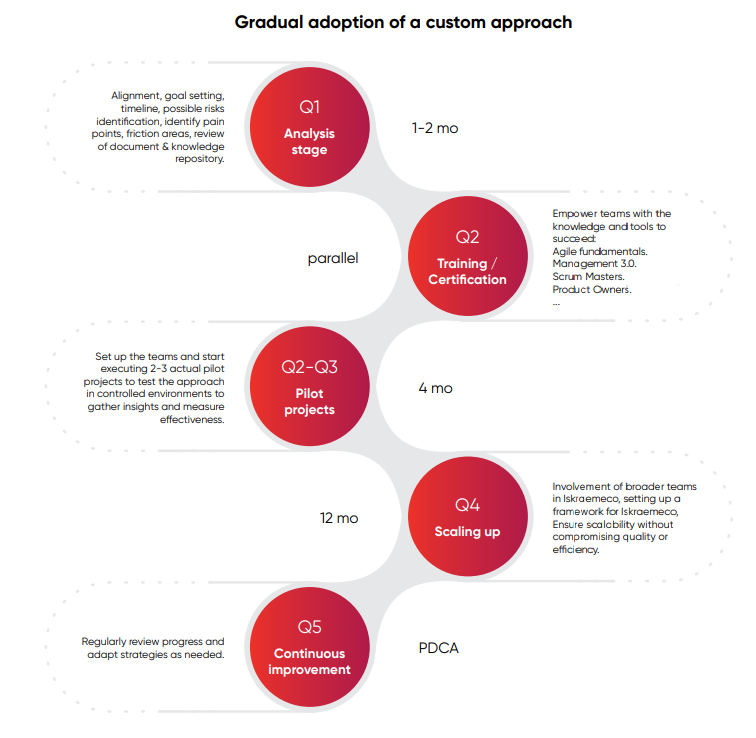
At Iskraemeco the agile approach is not new, but it is limited to following Agile rituals mainly in the SW development team. The broader adoption of Agile in Iskraemeco involves a gradual approach. We started with an analysis stage to align goals, set timelines, and identify potential risks to assess the readiness for introducing agile approaches. This is followed by pilot projects to test the model and approach in controlled environments,
continuous improvement through regular progress reviews, and training and certification to empower teams with the necessary knowledge and tools. Finally, the approach will be scaled up to involve broader teams within the organization.
Iskraemeco’s model
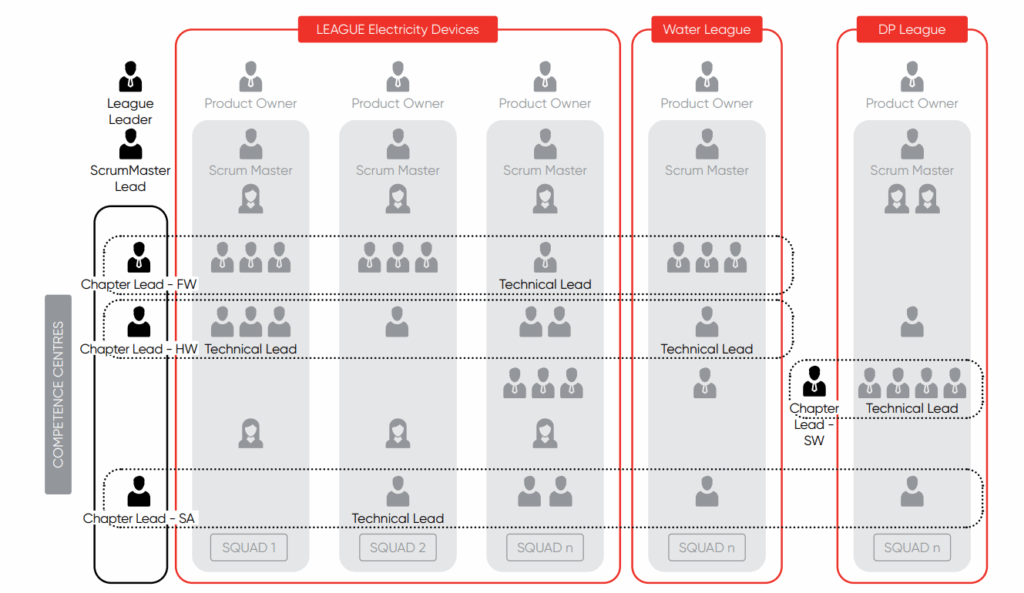
Agile is a philosophy and spirit and is supported by different frameworks and methodologies. Through the initial experimentation stage with the pilots, we will design a framework that we see fit for Iskraemeco where we are running different types of projects, such as development of devices, SW development, complex solutions combined of different devices, SW, integration architecture and services, and innovation projects. We however kicked off the pilots with the terminology deriving from “Scrum” and “Spotify” agile framework as shown in the picture below.
The main unit in Iskraemeco Agile model will be a scrum. A small self-organized group of cross-functional people ideally dedicated to working on a single product/solution. The key roles in a scrum are product owner, scrum master and technical lead representing the development team. All three roles are different to the existing job descriptions we have for a product manager or a project manager. The product owner is responsible to align product/solution vision with business goals, manage product/solution backlog (requirements) based on stakeholder needs and feedback, and prioritize features for maximum customer value. The scrum master is responsible for conducting effective agile rituals, fosters team collaboration and facilitate the team to make progress visible to stakeholders. The technical lead represents the development team and ensures the technical aspects of the product/solution are well-managed, works closely with the product owner and scrum master and other stakeholders to align technical solutions with business goals. In a scrum we will have several technical experts but one will be nominated to represent technical aspect of a specific product/solution.
More scrums are grouped into a league. Currently we see to have a league for electricity, digital platforms and water, coinciding with our business streams.
The important role of this model is also the role of a chapter lead. Chapters are groups of people with similar competencies responsible for a platform approach with the main responsibility to ensure stable and scalable platform development and prevent
branching. Chapters or competency centres are also meant for non-core development teams, such as manufacturing engineering, strategic procurement, component management, quality and other crucial functions playing roles in the interdisciplinary scrums.
Enabling the implementation
As written in the Scrum guide: “The Scrum framework is purposefully incomplete, only defining the parts required to implement Scrum theory. Scrum is built upon the collective intelligence of the people using it.” The role of our management is not to give a recipe exactly defining how the teams should work, but to communicate vision and product strategy, delegate decision-making authority, promote transparent communication and collaboration across teams, advocate for agile practices and principles, establish the working system, drive the process and organizational changes,
and allow for mistakes to encourage continuous learning. At this stage, we still need to address several areas to fully support the agile implementation and those will be addressed by the agile transformation core team during the experimentation stage and further on.
Conclusion
The adoption of Agile methodologies at Iskraemeco represents a significant shift towards a more customer-centric and adaptable approach to project management. The gradual implementation of Agile, starting with pilot projects and continuous improvement, ensures that the organization can adapt and refine its approach to best fit its unique needs and not jeopardising running business operations. The support and active involvement of management are crucial in driving this transformation, promoting transparency, and encouraging a culture of continuous learning and improvement. As Iskraemeco continues to embrace Agile, it will be well-positioned to respond to evolving requirements and deliver better results for our customers.